Well it has been rather a long time since I was able to put an update on here, but hopefully they’ll be a bit more frequent in the future.
I’ve not been entirely dormant during the hiatus, but have done precious little physical modelling and rather a lot of CAD modelling. That has built up quite a backlog of CAD projects that need to be turned into physical models. They should appear in due course, health providing.
Miss Severn has languish on my lounge floor during the break from modelling and has been a frequent reminder of what I’ve been missing. However, I’m back now and Miss Severn has been receiving some much needed attention.
The hull has finally been given its first coat of varnish. Finding a crystal clear varnish that is compatible with the Tamiya acrylic rattle can paint has been a tale in itself. I’ve tested numerous products, most of which caused the paint on the test samples to pucker up and wrinkle. I did try using traditional yacht varnish, but the tint in that made the aquamarine hull colour go a peculiar shade of green. Water based resins were OK, but didn’t really give me the finish that solvent based ones can. No pictures of the hull unfortunately as I didn’t want to disturb it while the varnish is hardening. Dust is a perennial problem here.
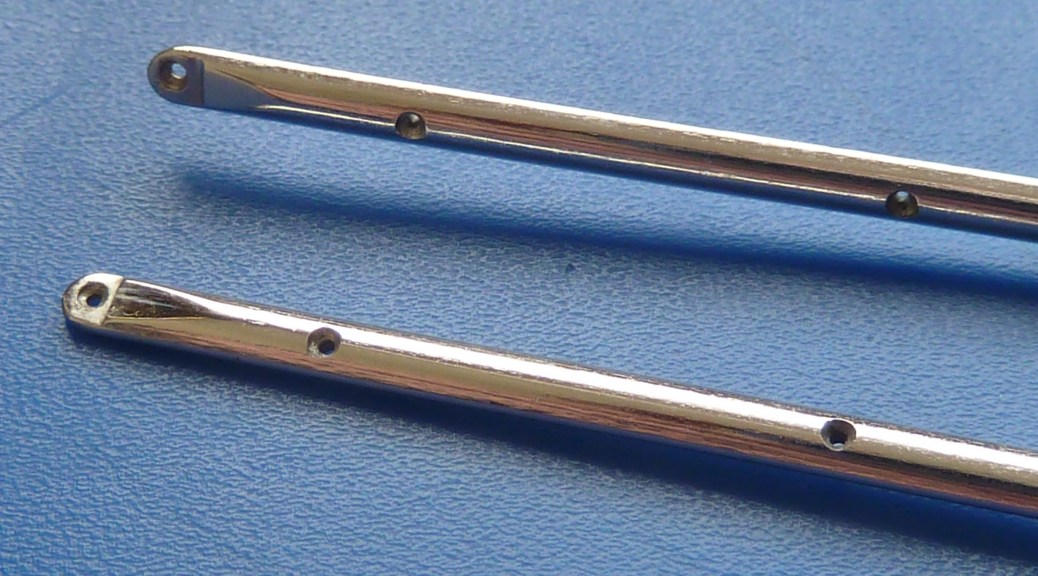
The other small bit of progress has been in bright nickel plating the rub rails for Miss Severn, and the Chris Craft 19′ Runabout. Miss Severn’s longest rails are about 40″ long which was much too large for my small facilities here. I did investigate sending them off to get them done professionally, but the quotes for that were also much too large.
In the end I opted to make a special plating tank out of 6mm PVC foam board and bought the necessary pure nickel anodes and titanium wire to connect them to the power supply. The whole affair looks a little Heath Robinson but does work surprisingly well. I was concerned about having a fairly unwieldy chemical bath knocking about in my garage but clamping it to the workbench makes it much more stable and an end tap allows 95% of the chemicals to drained off in situ. The bath only needs to be unclamped to recover the last few dregs.

The rails were polished up, cleaned with acetone, then given a copper strike coating. This isn’t strictly necessary with brass, but I wanted to make sure the bright nickel had a good base to adhere to. After the copper strike, the parts were given a quick rinse and then plated with bright nickel.

I’m happy with the result and it’s saved quite a few pennies.
 MBIQ Models